

American Flamingo
Overview
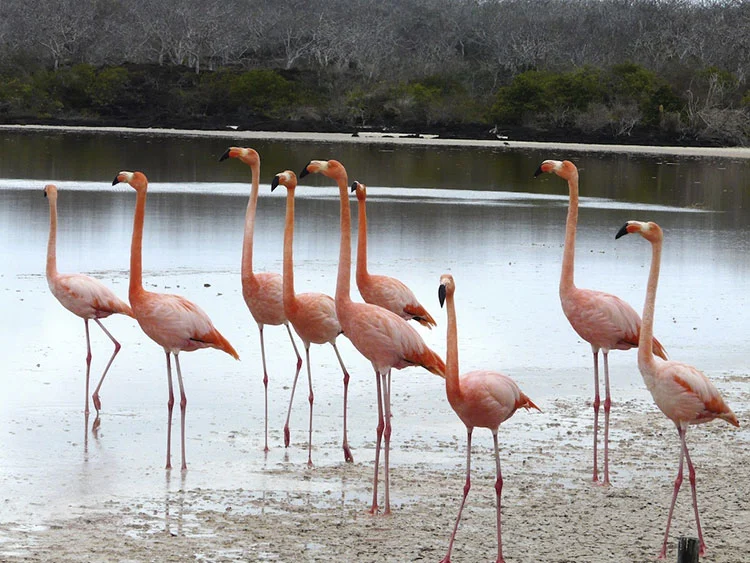
The American flamingo is the largest and most vividly colored bird in the Galápagos, found wading in a handful of shallow, saline coastal lagoons across the archipelago — an unexpected splash of pink against the islands’ volcanic black and green.
Physical Characteristics
Tall and long-necked, with distinctive downward-bent bills used upside-down for filter feeding, and vivid pink-to-orange plumage that comes entirely from pigments in its diet rather than from the bird itself.
Habitat
Shallow, brackish coastal lagoons with soft mud bottoms, where filter feeding is easiest and nesting mounds can be built above the waterline.
Distribution
Scattered in small numbers across a few lagoons, most notably Cormorant Point on Floreana and lagoons near Puerto Villamil on Isabela; also occasionally seen on Rábida and Santa Cruz.
Diet
Brine shrimp, small aquatic invertebrates, and algae, all rich in the carotenoid pigments responsible for the bird’s pink coloration.
Feeding Behaviour
Feeds by sweeping its specially adapted, downward-curved bill through shallow water and mud, using comb-like structures inside the bill to filter out small food particles — the same basic mechanism used by flamingos worldwide.
Reproduction
Builds a cone-shaped mud mound nest just above the waterline, typically laying a single egg. Chicks are grey-white at hatching and only develop pink coloration gradually over one to two years as their diet accumulates pigment.
Courtship
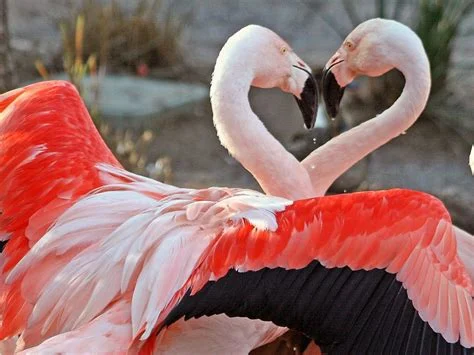
Performs synchronized group displays, including head-flagging (rapid side-to-side head turns) and wing-saluting, in which several birds display together — a behaviour more often associated with much larger mainland flocks but still visible in the Galápagos’s smaller groups.
When to Observe It
Best seen at Floreana’s Cormorant Point lagoon or the Puerto Villamil lagoons on Isabela; small numbers can be present year-round, though visibility depends on water levels.
Evolution
The Galápagos flamingo population is thought to have arrived from mainland Caribbean or South American populations and, though not a distinct species, has remained isolated long enough to be recognized as a genetically distinct population with unusually low numbers for the species.
Conservation
The species overall is of Least Concern, but the small, isolated Galápagos population — estimated at only a few hundred individuals — makes local habitat quality in just a handful of lagoons disproportionately important to its survival here.
Galápagos Connection
The archipelago’s flamingo lagoons are among the few places in the islands where a visitor can see a large, unmistakably tropical wading bird alongside the volcanic landscapes and marine wildlife the Galápagos are better known for.
Naturalist Insight
Flamingo chicks hatch grey, not pink — the vivid color visitors associate with the species only develops gradually as carotenoid pigments from their crustacean-rich diet accumulate in their feathers, meaning a young, pale bird in a Galápagos lagoon is often simply too young to have “colored in” yet.
At a Glance
| Scientific Name | Phoenicopterus ruber |
|---|---|
| Typical Size | Up to 1.4 m tall |
| Diet | Brine shrimp, small crustaceans, algae |
| Conservation Status | Least Concern globally; the isolated Galápagos population numbers only a few hundred birds |
Observe it on
More Species to Discover
A lifetime of Galápagos knowledge, gathered into one ebook.
Receive the EbookCurated by naturalists born in the Galápagos — see who's behind this knowledge