

Darwin’s Finch
Overview
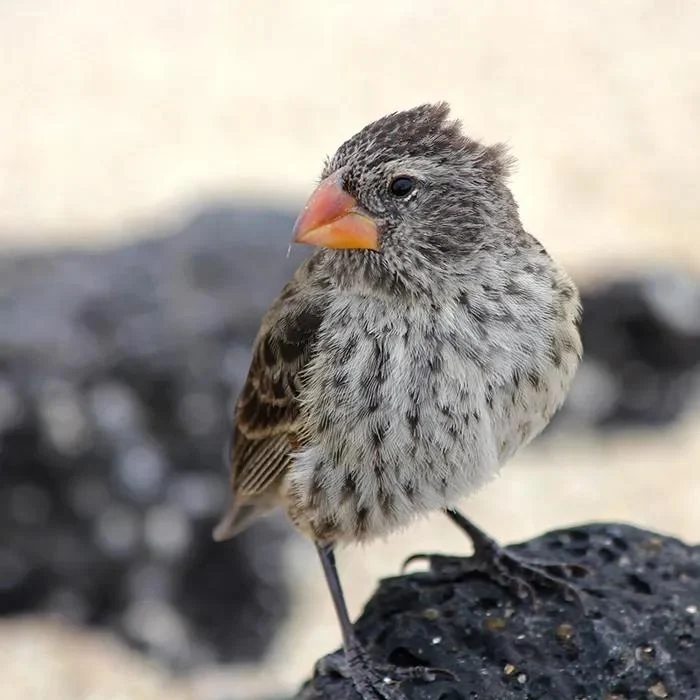
Darwin’s finches are a group of small, closely related songbirds found only in the Galápagos, famous as one of the clearest real-world examples of evolution by natural selection. Despite their name, Charles Darwin did not immediately recognize their significance during his 1835 visit — it was the ornithologist John Gould who later identified his mismatched specimens as a single family of closely related species.
Physical Characteristics
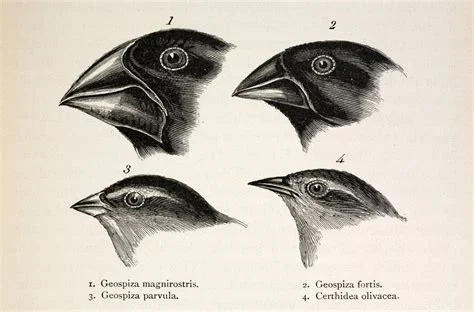
Individually unremarkable — small, mostly brown, grey or black songbirds — the group’s significance lies almost entirely in beak shape and size, which varies dramatically between species: thick, powerful crushing beaks in ground finches that feed on hard seeds; slender, probing beaks in species that feed on insects or cactus; even a stout, parrot-like beak in the vegetarian finch.
Habitat
Different species occupy different habitats across the same islands, from arid coastal scrub to humid highland forest, reducing direct competition between them.
Distribution
Collectively found across nearly the entire archipelago, though many individual species are far more habitat- or island-specific — the mangrove finch, for example, survives only in a single small patch of mangrove forest on Isabela and is one of the rarest birds in the world.
Diet
Varies by species: seeds of different hardness, insects and larvae, cactus flowers, pollen and pulp. The sharp-beaked ground finch population on Wolf and Darwin islands supplements its diet by pecking at the skin of nesting seabirds to drink their blood, a highly unusual habit that earned it the nickname “vampire finch.”
Feeding Behaviour
The woodpecker finch is one of the very few birds known to use tools in the wild, holding a cactus spine or twig in its beak to winkle insect larvae out of tree bark and crevices.
Reproduction
Builds a domed nest with a side entrance, typically in a tree, shrub, or cactus. Clutch size and breeding timing are closely tied to rainfall, since seed and insect abundance both depend on it.
Courtship
Males typically build several candidate nests and sing from each to attract a female, who inspects the structures before choosing both nest and mate.
When to Observe It
Present year-round across most inhabited and visited islands; several species can often be seen in a single morning walk, especially in highland vegetation zones.
Evolution
Darwin’s finches are the textbook example of adaptive radiation: a single ancestral species that reached the islands roughly 1–2 million years ago diversified into more than a dozen descendant species, each shaped by natural selection to exploit a different available food source. Decades of direct field study on Daphne Major by biologists Peter and Rosemary Grant documented measurable shifts in beak size within finch populations across just a few generations, following droughts and El Niño events — a rare case of evolution observed in real time rather than inferred from the fossil record.
Conservation
Most species remain common, but a few face serious threats: the mangrove finch is Critically Endangered, and several species are vulnerable to the introduced parasitic fly Philornis downsi, whose larvae attack nestlings. The Charles Darwin Foundation runs active nest-monitoring and captive-rearing programs for the most at-risk species.
Galápagos Connection
Few animals are as closely tied to the islands’ scientific identity — the finches are frequently cited as one of the observations that helped shape Darwin’s thinking toward natural selection, even though his own notes on them were initially incomplete.
Naturalist Insight
The Grants’ long-term study of finches on Daphne Major remains one of the most detailed records of natural selection ever assembled for a wild vertebrate population: after a severe drought reduced the supply of small, soft seeds, birds with slightly larger, deeper beaks — better suited to cracking the tougher seeds that remained — survived at higher rates, and the average beak size of the population measurably increased within a single generation.
At a Glance
| Scientific Name | Geospiza and related genera (13–18 recognized species) |
|---|---|
| Typical Size | 10–20 cm depending on species |
| Diet | Seeds, insects, cactus flowers/pulp; blood in one island-restricted species |
| Conservation Status | Varies by species — Least Concern to Critically Endangered (mangrove finch) |
Observe it on
More Species to Discover
A lifetime of Galápagos knowledge, gathered into one ebook.
Receive the EbookCurated by naturalists born in the Galápagos — see who's behind this knowledge