

Magnificent Frigatebird
Overview
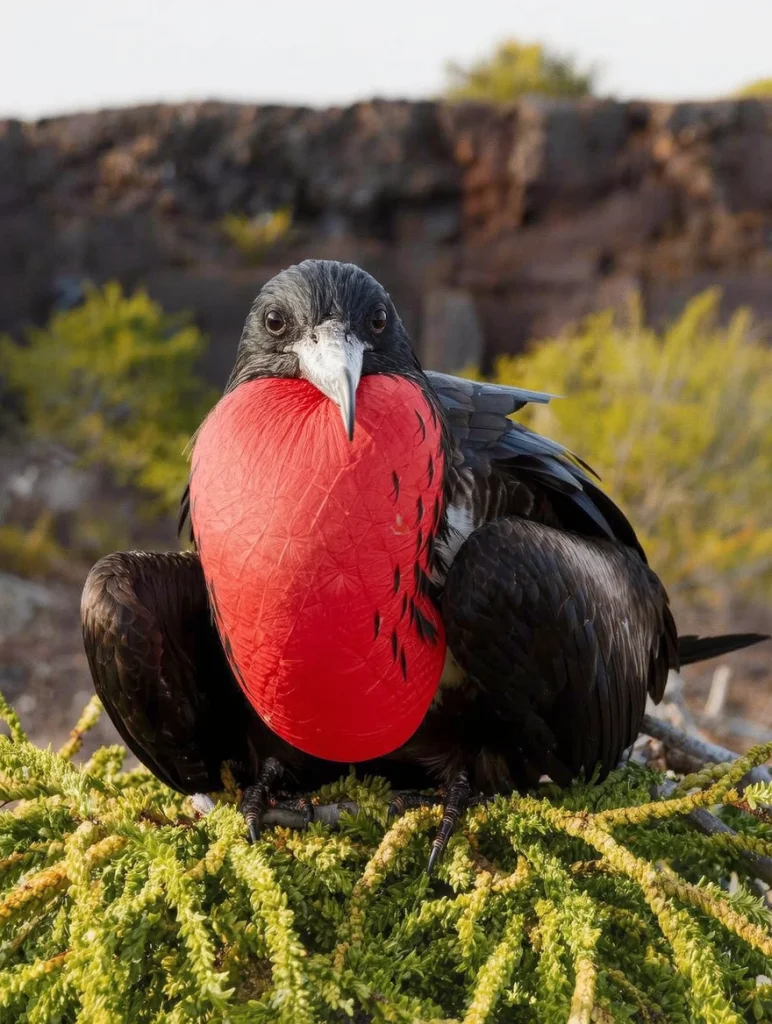
A large seabird best known for the male’s dramatic, balloon-like red throat pouch, inflated during courtship. Two very similar species occur in the Galápagos: the magnificent frigatebird and the great frigatebird.
Physical Characteristics
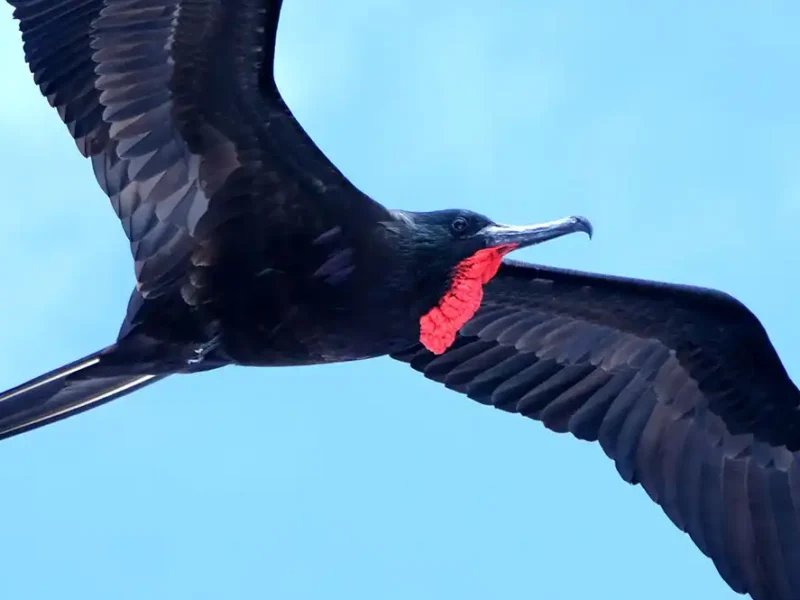
Males are entirely black with a long forked tail and a long hooked bill; females show a white breast patch. Frigatebirds have the largest wing-area-to-body-weight ratio of any bird, thanks to an unusually light skeleton, which lets them stay aloft for extended periods.
Habitat
Coastal cliffs, mangroves, and low vegetation for nesting; otherwise spends much of its time soaring over open ocean and coastline.
Distribution
Found throughout the Galápagos, with major breeding colonies on North Seymour and Genovesa.
Diet
Fish, especially flying fish, and squid taken from the ocean surface.
Hunting Behaviour
Frigatebirds cannot land on water — their plumage isn’t waterproof and they struggle to take off again from the surface — so they snatch prey directly from the waves in flight, or harass other seabirds such as boobies and tropicbirds into dropping their catch, a habit that earned them the old nickname “man o’ war bird.”
Reproduction
Lays a single egg. The full cycle from egg to an independent, flying chick can take well over a year, meaning most pairs breed only once every two years.
Courtship
Males gather in groups and inflate their red gular pouch like a balloon over roughly 20 minutes, drumming it with the bill and calling to attract females flying overhead — one of the most visually striking courtship displays among seabirds.
When to Observe It
Present year-round; males display their inflated pouches most conspicuously during the main breeding season, which varies somewhat between colonies.
Evolution
Extreme adaptations for lightness and lift reflect a lifestyle built almost entirely around sustained flight, with the birds rarely landing except to breed.
Conservation
Listed as Least Concern by the IUCN for both species present in the islands.
Galápagos Connection
North Seymour Island is one of the most reliable places anywhere to watch displaying males up close.
Naturalist Insight
Tracking studies on frigatebirds elsewhere in their range have shown they can remain continuously airborne for weeks, sleeping in short bursts while gliding — a capacity, alternating rest between brain hemispheres, shared with only a handful of other bird groups known to sleep on the wing.
At a Glance
| Scientific Name | Fregata magnificens |
|---|---|
| Typical Size | Wingspan up to 2.3 m |
| Diet | Fish and squid, often stolen mid-air from other birds |
| Conservation Status | Least Concern (IUCN) |
Observe it on
More Species to Discover
A lifetime of Galápagos knowledge, gathered into one ebook.
Receive the EbookCurated by naturalists born in the Galápagos — see who's behind this knowledge