

Scalloped Hammerhead Shark

Overview
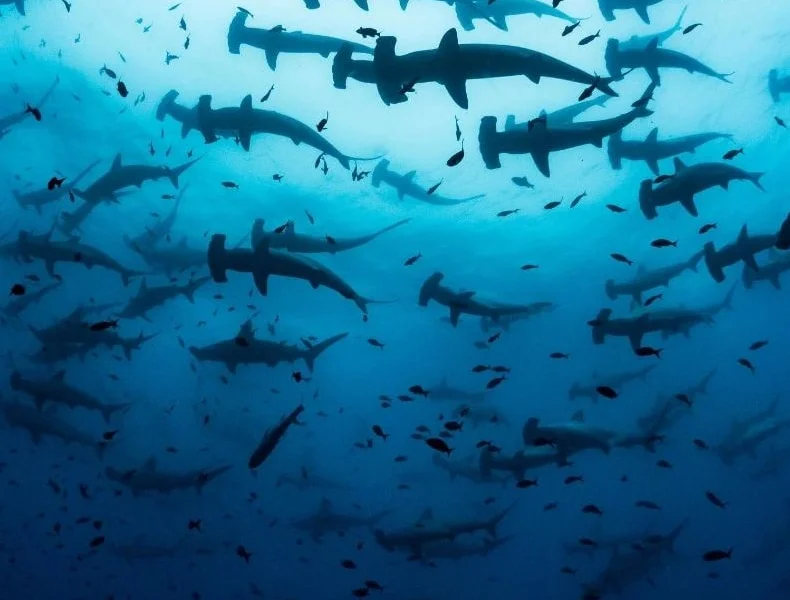
One of the Galápagos Marine Reserve’s most famous predators, known for gathering in large daytime schools around the archipelago’s remote northern islands.
Physical Characteristics
A distinctive flattened, scalloped-edged head called a cephalofoil, lined with sensory organs, grey-brown coloring, and a length that can reach 3.5 to 4 metres.
Habitat
Open water near seamounts and offshore islands, typically where strong currents bring cold, nutrient-rich water to the surface.
Distribution
Found worldwide in warm temperate and tropical seas. The waters around Darwin and Wolf, in the far north of the Galápagos Marine Reserve, are internationally recognized for exceptionally large aggregations.
Diet
Fish, squid, and other sharks and rays.
Hunting Behaviour
The hammer-shaped head spreads its electroreceptors — the ampullae of Lorenzini — over a wider area than a conventional shark head, improving its ability to detect prey hidden in the sand, such as stingrays. Despite schooling during the day, individuals typically disperse to hunt alone at night.
Reproduction
Viviparous, giving live birth to litters of roughly 15 to 30 pups after a gestation of around 9 to 10 months. Shallow coastal waters serve as nursery grounds for the young.
Social Behaviour
The large daytime schools observed at Darwin and Wolf are thought to relate to social structure, though the exact function is still studied by researchers.
When to Observe It
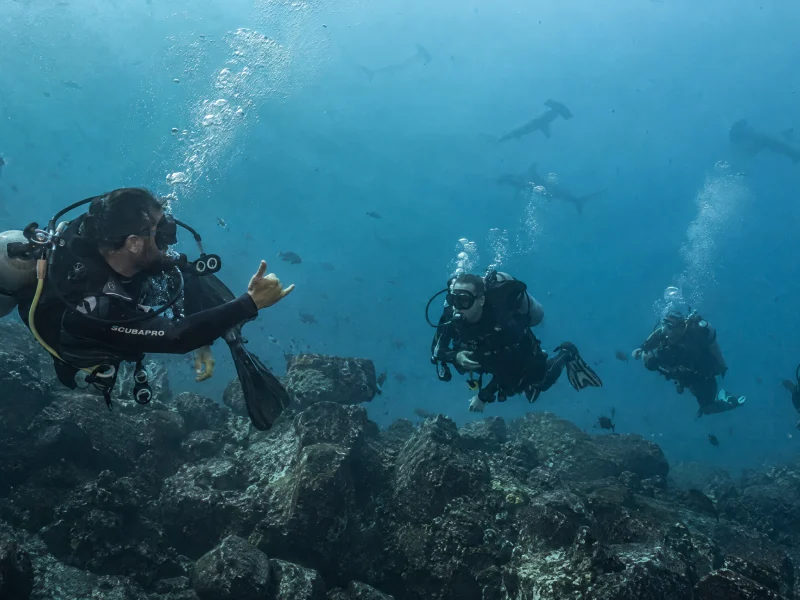
Present year-round at Darwin and Wolf, though these sites are reached only by liveaboard dive vessels rather than standard day cruises.
Evolution
Hammerhead sharks are a comparatively recent shark lineage; the cephalofoil is thought to improve both maneuverability and sensory range, both advantageous to their hunting style.
Conservation
Listed as Critically Endangered by the IUCN. Global populations have been heavily reduced by shark finning, making the Galápagos Marine Reserve one of the last strongholds where large aggregations still occur.
Galápagos Connection
The reserve’s protection of these schooling aggregations is frequently cited as one of its most significant conservation achievements.
Naturalist Insight
Genetic studies suggest scalloped hammerheads show strong fidelity to particular aggregation sites, with some population structuring between locations. That implies the Galápagos population may be more genetically distinct — and less replaceable if lost — than researchers once assumed.

At a Glance
| Scientific Name | Sphyrna lewini |
|---|---|
| Typical Size | Up to 3.5–4 m |
| Diet | Fish, squid, other sharks and rays |
| Conservation Status | Critically Endangered (IUCN) |
Observe it on
More Species to Discover
A lifetime of Galápagos knowledge, gathered into one ebook.
Receive the EbookCurated by naturalists born in the Galápagos — see who's behind this knowledge