

Galápagos Land Iguana
Overview
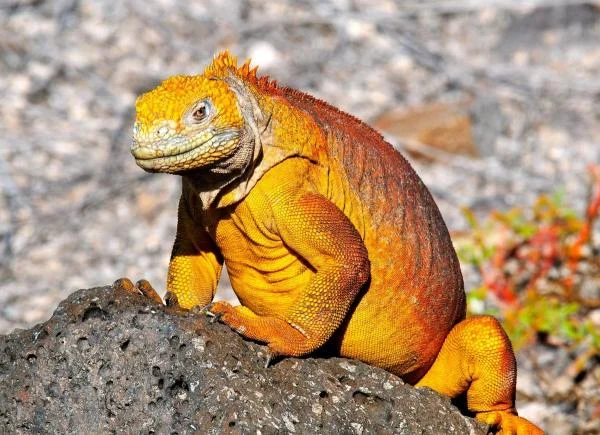
The Galápagos land iguana is one of the archipelago’s most visually striking reptiles, with a heavy, dragon-like build and a distinctive yellow-to-orange coloring quite different from its close relative, the marine iguana.
Physical Characteristics
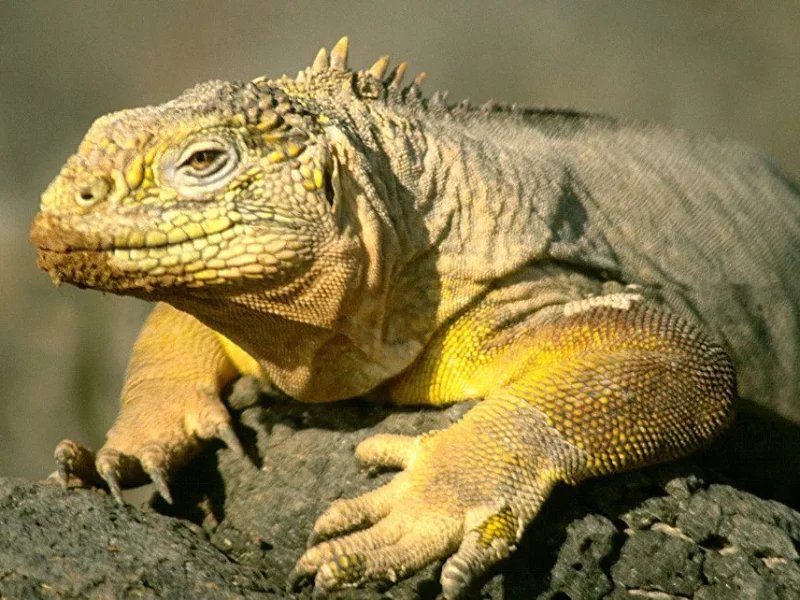
Large and robust, with a crest of short spines running down its back, blunt claws well suited to digging, and coloring that ranges from dull yellow to a vivid burnt orange depending on the individual and island population.
Habitat
Arid lowland zones with abundant Opuntia (prickly pear) cactus, from lava fields to dry scrubland; digs burrows for shelter from heat and predators.
Distribution
Present on several islands including Fernandina, Isabela, Santa Cruz, and South Plaza, with the North Seymour population descended from iguanas relocated from Baltra in the 1930s as a safeguard against local extinction.
Diet
Feeds mainly on the pads, flowers, and fruit of the Opuntia cactus, spines included, and obtains most of its water needs from this same plant, allowing it to survive long dry seasons with little standing water.
Feeding Behaviour
Will wait beneath Opuntia cacti for pads or fruit to fall, and has even been observed using a head-butting or biting technique to knock cactus pads loose rather than simply grazing on what has already fallen.
Reproduction
Females may travel several kilometers to reach suitable sandy nesting ground, where they dig burrows and lay 2 to 25 eggs depending on the population, guarding the nest site for a period afterward before leaving the eggs to incubate unattended.
Courtship
Males establish and defend territories through head-bobbing displays and, when necessary, physical combat with rivals; successful males mate with multiple females within their territory.
When to Observe It
South Plaza and North Seymour offer some of the most reliable, close-range sightings; Fernandina and Isabela host wild populations as well, generally in drier lowland visitor sites.
Evolution
Land and marine iguanas share a common ancestor that is thought to have rafted to the islands several million years ago and then split into two very different lineages — one adapting to feed on land vegetation, the other to graze on marine algae — a striking example of divergent evolution from a single founding population.
Conservation
Listed as Vulnerable, having been driven to local extinction on Baltra by introduced feral cats and the construction of a US military base during World War II. The Baltra population was later restored through a Charles Darwin Research Station breeding program using the related North Seymour population as source stock — one of the Galápagos’s clearest conservation recovery stories.
Galápagos Connection
The land iguana’s recovery on Baltra, engineered using iguanas originally moved off the island as a precaution decades earlier, is frequently cited alongside the giant tortoise breeding programs as proof that careful, patient conservation work in the islands can reverse even a full local extinction.
Naturalist Insight
The North Seymour land iguana population exists today only because a small group was deliberately relocated there from Baltra in the 1930s as an insurance measure — decades later, when the original Baltra population was wiped out, that same relocated group became the source stock used to bring iguanas back to the island they’d been moved away from.
At a Glance
| Scientific Name | Conolophus subcristatus (and related species, incl. Conolophus pallidus on Santa Fe) |
|---|---|
| Typical Size | Up to 1.1 m long, up to 13 kg |
| Diet | Mainly Opuntia cactus pads, fruit and flowers; opportunistic insects |
| Conservation Status | Vulnerable (IUCN) |
Observe it on
More Species to Discover
A lifetime of Galápagos knowledge, gathered into one ebook.
Receive the EbookCurated by naturalists born in the Galápagos — see who's behind this knowledge