

Galápagos Penguin
Overview
The Galápagos penguin is the only penguin species found north of the equator in the wild, and one of the rarest penguins on Earth — a striking presence given that most of its relatives live in far colder southern latitudes.
Physical Characteristics
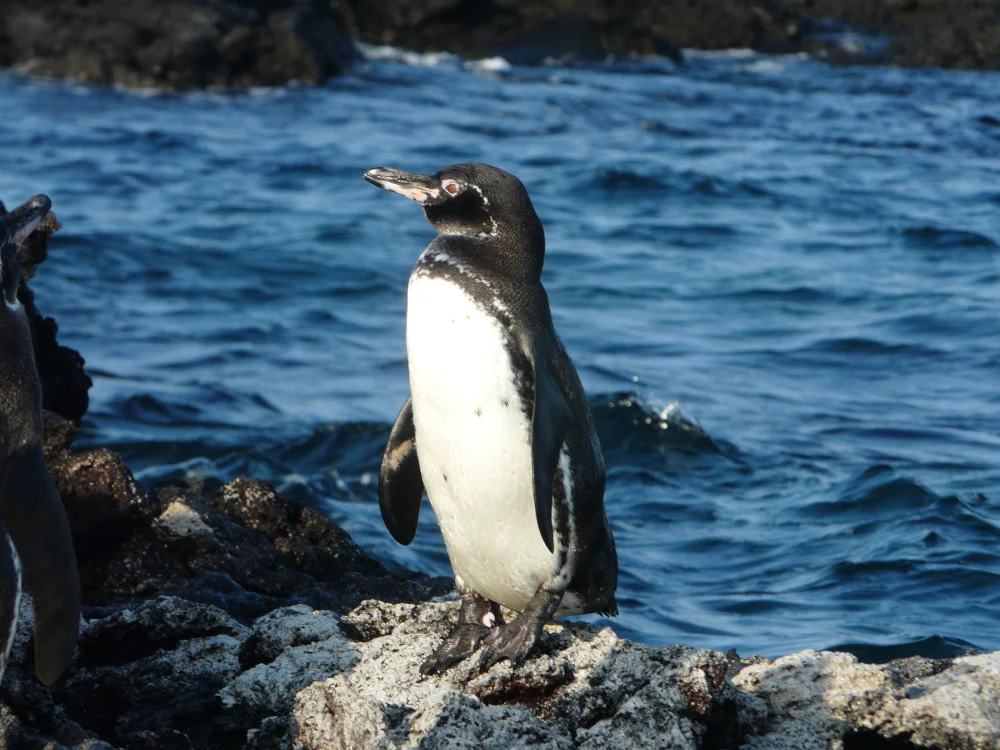
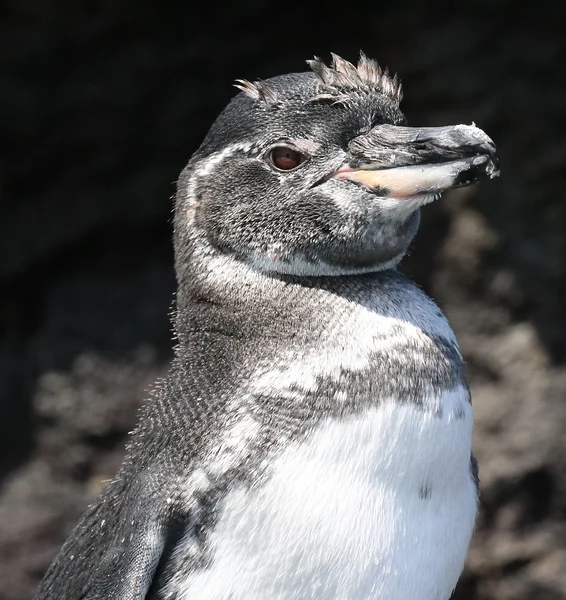
Small and slender compared to most penguin species, with a black head bordered by a thin white line, a black band across the white chest, and pink patches of bare skin around the eyes and beak base that help it shed excess heat in the tropical sun.
Habitat
Rocky volcanic shorelines with easy access to cold, nutrient-rich water; nests in caves, crevices, and burrows in lava rock, which shade eggs and chicks from direct equatorial sun.
Distribution
Almost entirely restricted to Fernandina and the western coast of Isabela, where the cold Cromwell Current wells up close to shore; small numbers are also seen on Bartolomé and Santiago.
Diet
Small schooling fish such as mullet and sardines, hunted in short, fast pursuit dives close to shore.
Hunting Behaviour
Often hunts cooperatively in small groups, herding schools of fish into shallow water or against rocks to feed more efficiently — a strategy also used by some of the sea lions sharing the same waters.
Reproduction
Unlike most penguins, breeding isn’t tied to a fixed season — pairs nest opportunistically whenever cold water and food supply allow, sometimes raising two broods in a good year and none at all during a poor one.
Courtship
Monogamous and typically long-term with the same partner across multiple breeding attempts; mutual preening and bill-tapping displays help reinforce the pair bond between nesting cycles.
When to Observe It
Most reliably seen along the Bolívar Channel between Isabela and Fernandina, and around Bartolomé’s Pinnacle Rock, where they are often spotted porpoising through the water or resting on the rocks.
Evolution
The species’ ancestors are thought to have arrived from the south by riding the cold Humboldt Current north, then adapted to equatorial conditions largely thanks to the Cromwell Current’s cold upwelling, which keeps the surrounding water far cooler than the tropical latitude would otherwise allow.
Conservation
Listed as Endangered, with a total population estimated at only around 1,000–2,000 individuals. El Niño events, which suppress the cold-water upwelling the species depends on for food, can cause sharp population crashes, making this one of the most climate-sensitive species in the archipelago.
Galápagos Connection
The Galápagos penguin’s presence this close to the equator is a direct, visible consequence of the same confluence of ocean currents that makes the islands’ marine life so unusually rich for a tropical latitude.
Naturalist Insight
Because its entire population depends on a narrow band of cold, nutrient-rich water, the Galápagos penguin is often used by researchers as an early indicator species for El Niño conditions — a poor breeding season here can be one of the first visible signs of a broader shift in the eastern Pacific’s ocean currents.
At a Glance
| Scientific Name | Spheniscus mendiculus |
|---|---|
| Typical Size | About 49 cm tall, ~2.5 kg — the second-smallest penguin species |
| Diet | Small schooling fish — mullet, sardines, anchovies |
| Conservation Status | Endangered (IUCN) |
Observe it on
More Species to Discover
A lifetime of Galápagos knowledge, gathered into one ebook.
Receive the EbookCurated by naturalists born in the Galápagos — see who's behind this knowledge