

Galápagos Giant Tortoise
Overview
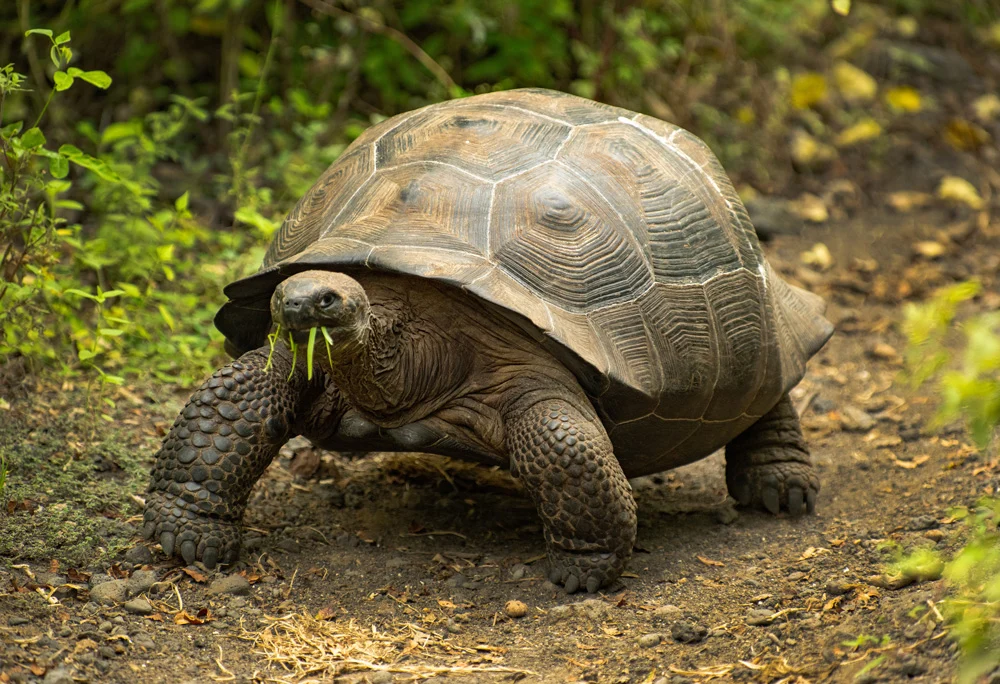
The giant tortoise is the archipelago’s most iconic resident, and the animal that gave the islands their name — “galápago” is old Spanish for saddle, describing the shape of some tortoises’ shells.
Physical Characteristics
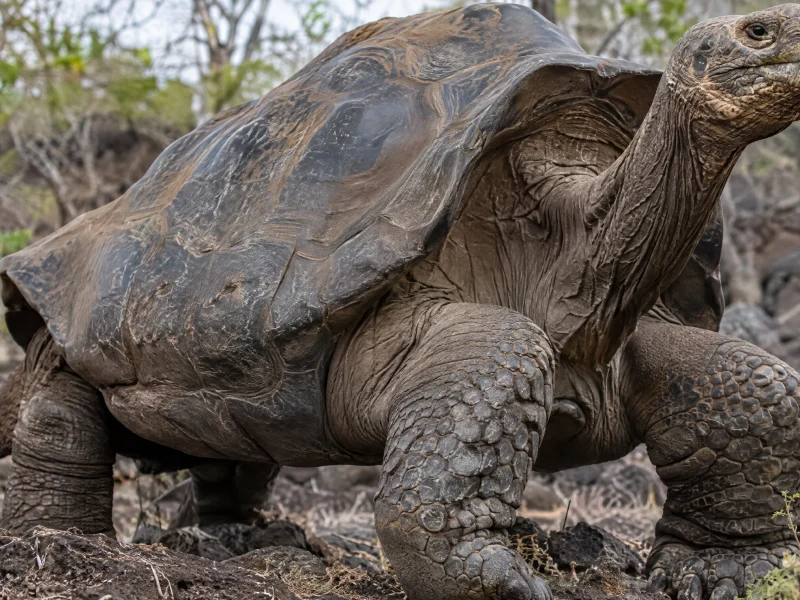
The largest living tortoise species, capable of exceeding 250 kg and living well beyond a century. Two shell shapes occur: domed shells, rounder and found on islands with lush highland vegetation, and saddleback shells, which curve upward at the front, found on drier islands and allowing the tortoise to stretch its neck higher to reach cactus pads and sparse vegetation.
Habitat
Ranges from arid lowlands to lush highland areas, with tortoises on larger islands often migrating seasonally between the two.
Distribution
Found across several islands, with distinct species or subspecies on different islands — and even on different volcanoes of Isabela — making the group a textbook case of isolation-driven speciation.
Diet
Herbivorous, feeding on grasses, leaves, cactus pads, and fruit.
Feeding Behaviour
A slow metabolism and the ability to store large reserves of food and water let giant tortoises go for extended periods without eating or drinking. Historically, this same trait made them a target for passing ships, which took live tortoises aboard as a source of fresh meat that could survive for months in a hold without care.
Reproduction
Females travel to sandy nesting areas to lay clutches of roughly 2 to 20 eggs, depending on the species, which incubate in the sand for around 4 to 8 months. As with many reptiles, nest temperature determines the sex of the hatchlings.
Behaviour
Generally solitary or loosely aggregated. Males establish dominance through neck-stretching contests, particularly around mating, with the tortoise able to reach highest generally asserting dominance.
When to Observe It
The highland reserves of Santa Cruz offer reliable wild sightings; several other islands also host their own populations.
Evolution
Shell shape evolved differently on different islands in response to local vegetation and climate: domed shells on humid islands with abundant ground-level plants, saddleback shells on arid islands where reaching higher, sparser vegetation such as cactus pads offered a survival advantage.
Conservation
Most giant tortoise species or subspecies are listed as Vulnerable, Endangered, or Critically Endangered. Historic hunting by whalers and pirates, along with introduced species — goats competing for food, rats and pigs preying on eggs — devastated populations. “Lonesome George,” the last known Pinta Island tortoise, died in 2012, marking the extinction of his subspecies. Breeding and repatriation programs run by the Galápagos National Park and the Charles Darwin Foundation have since brought several other populations back from the brink.
Galápagos Connection
The giant tortoise is the namesake of the entire archipelago and remains its single most powerful conservation icon.
Naturalist Insight
The extinction of the Pinta Island tortoise with the death of Lonesome George in 2012 was a stark reminder of how fragile island endemism can be. Since then, tortoises found to carry partial Pinta or Floreana ancestry — identified through genetic testing of mixed populations elsewhere — have become the basis of breeding programs attempting to functionally restore those lost island lineages.
At a Glance
| Scientific Name | Chelonoidis niger (species complex) |
|---|---|
| Typical Size | Up to 250+ kg, shell length over 1.2 m |
| Diet | Herbivore — grasses, cactus pads, fruit |
| Conservation Status | Vulnerable to Critically Endangered, depending on species |
Observe it on
More Species to Discover
A lifetime of Galápagos knowledge, gathered into one ebook.
Receive the EbookCurated by naturalists born in the Galápagos — see who's behind this knowledge