

Orca
Overview
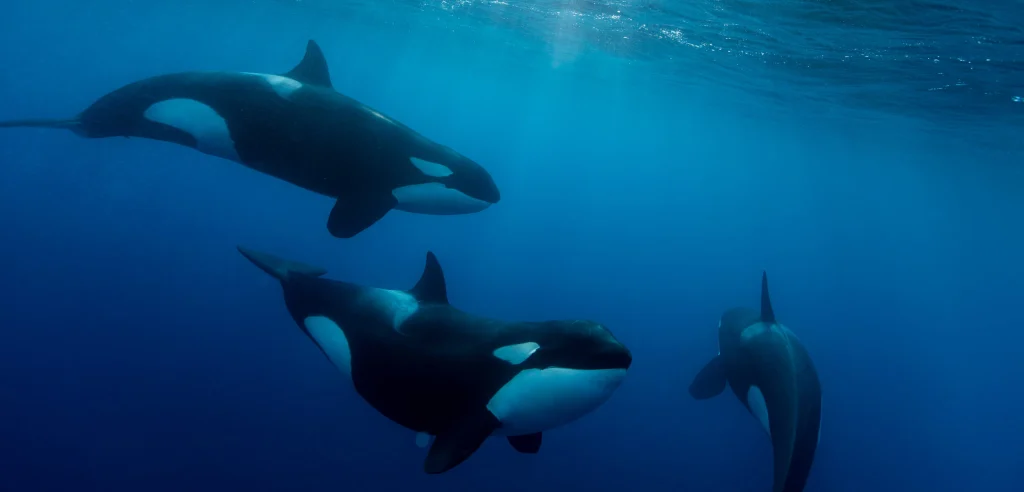
The orca, or killer whale, is the ocean’s largest dolphin and an apex predator found in every ocean on Earth. In the Galápagos it appears only as an occasional, unpredictable visitor rather than a resident species, which makes any sighting a genuinely rare privilege.
Physical Characteristics
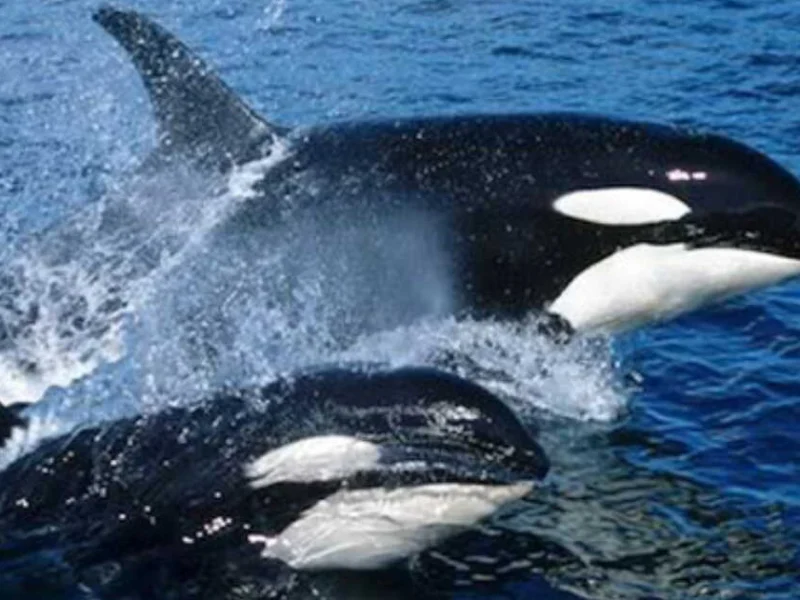
Instantly recognizable by its bold black-and-white coloring, tall dorsal fin — especially prominent in adult males — and powerful, muscular build built for speed and endurance over long ocean distances.
Habitat
Open and coastal waters; in the Galápagos, most often associated with the nutrient-rich, current-swept waters of the Bolívar Channel between Isabela and Fernandina, the same productive stretch of sea that supports much of the archipelago’s marine mammal and seabird life.
Distribution
Globally, the most widely distributed marine mammal on the planet. Around the Galápagos it is not resident but passes through in transient pods, with sightings reported irregularly throughout the year rather than on a predictable seasonal pattern.
Diet
Highly adaptable, ranging from fish and rays to sea lions and other marine mammals, depending on the population and region — Galápagos sightings have included orcas hunting sea lions and rays.
Hunting Behaviour
Hunts cooperatively in coordinated pods, using group strategies to corner or exhaust prey — behaviour occasionally observed even during brief Galápagos visits, when a pod moves through hunting grounds shared with sea lions and rays.
Reproduction
Gestation lasts around 15–18 months, and calves typically stay close to their mother for several years, learning hunting techniques that can vary significantly between different orca populations worldwide.
Social Structure
Highly social, living in tight-knit family pods led by older females; pod members cooperate closely in hunting and calf-rearing, and vocal “dialects” can differ distinctly between separate populations.
When to Observe It
Impossible to predict reliably — most Galápagos sightings are chance encounters during channel crossings near Isabela and Fernandina, which is exactly what makes them so memorable when they happen.
Evolution
As a highly adaptable, cosmopolitan apex predator, the orca has diversified into several distinct ecotypes worldwide, each specializing in different prey and hunting techniques — a level of behavioural, rather than purely physical, adaptation that is unusual even among marine mammals.
Conservation
Globally listed as Data Deficient by the IUCN due to uncertainty over distinct population sizes; there is no resident population in the Galápagos Marine Reserve to track, so local sightings are documented opportunistically by guides and researchers rather than through a dedicated monitoring program.
Galápagos Connection
An orca sighting is one of the least predictable and most sought-after wildlife moments a Galápagos cruise can offer — a reminder that even in one of the best-studied marine reserves in the world, the ocean still holds surprises.
Naturalist Insight
Because orcas are only occasional visitors rather than a resident Galápagos species, naturalist guides generally treat a confirmed sighting as a genuine event worth logging — unlike the marine iguanas or sea lions guests can expect to see on almost any landing, an orca encounter is never guaranteed, which is part of what makes it so memorable.
At a Glance
| Scientific Name | Orcinus orca |
|---|---|
| Typical Size | Up to 8–9 m, among the largest dolphins in the world |
| Diet | Sea lions, fish, rays, other marine mammals |
| Conservation Status | Data Deficient globally (IUCN); no resident Galápagos population |
Observe it on
More Species to Discover
A lifetime of Galápagos knowledge, gathered into one ebook.
Receive the EbookCurated by naturalists born in the Galápagos — see who's behind this knowledge