

Red-footed Booby
Overview
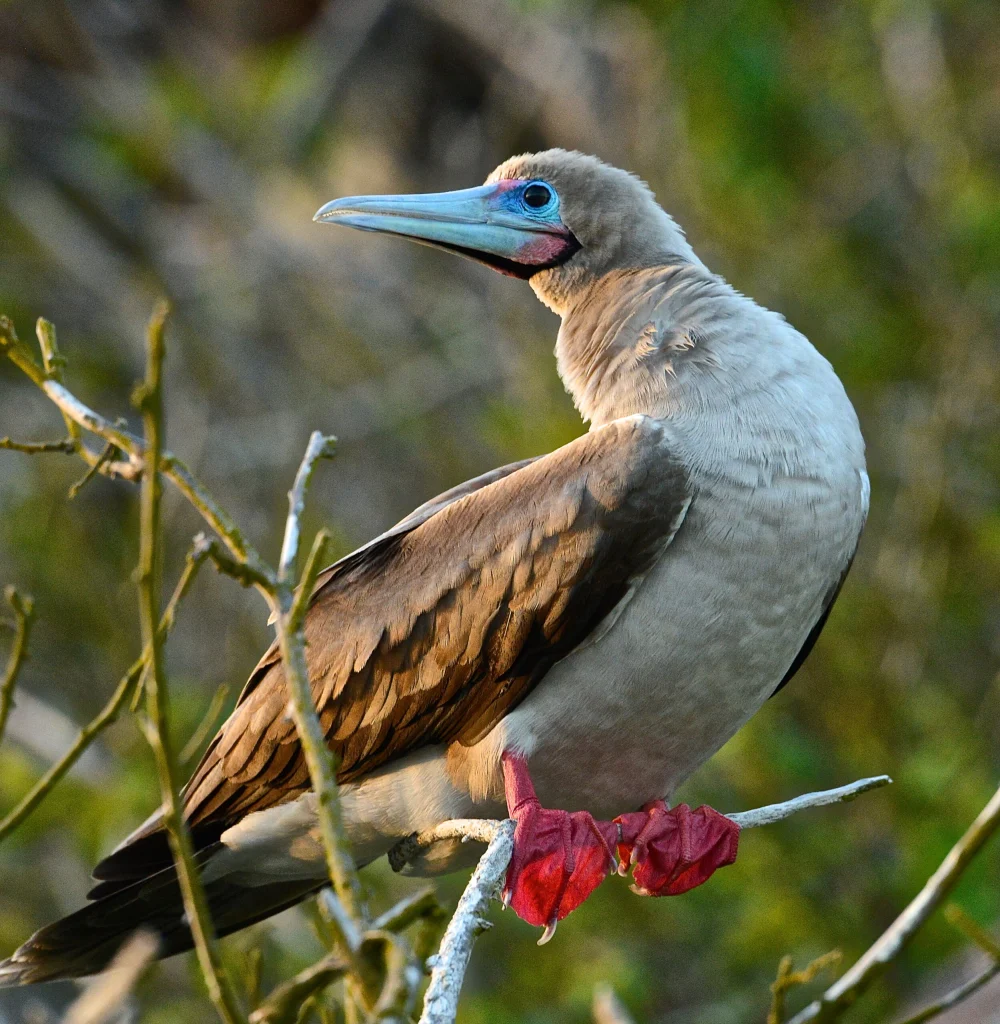
The smallest and most numerous of the three Galápagos booby species, and the only one that nests in trees and shrubs rather than on open ground.
Physical Characteristics
Red-footed boobies occur in two color morphs — brown and white — but all have bright red feet and a blue-and-pink bill. They are noticeably smaller and more slender than the blue-footed or Nazca booby.
Habitat
Nests in trees and low shrubs, including mangroves, unlike the ground-nesting blue-footed and Nazca boobies.
Distribution
Widely distributed across tropical oceans worldwide. In the Galápagos, the largest colonies are on Genovesa and at Punta Pitt on San Cristóbal.
Diet
Small fish, especially flying fish, and squid.
Hunting Behaviour
Plunge-dives for prey, often further offshore than other boobies, and hunts more at night than its relatives — likely taking advantage of moonlight to catch flying fish and squid rising toward the surface.
Reproduction
Lays a single egg, unlike the one-to-three eggs of other Galápagos boobies. The breeding cycle is long, with chick-rearing taking several months.
Courtship
Displays sky-pointing and bill presentations while perched in trees — courtship behaviour shaped by its unusual arboreal nesting habit.
When to Observe It
Visible year-round on Genovesa, particularly around Prince Philip’s Steps and El Barranco.
Evolution
Nesting in trees rather than on the ground is thought to reduce competition with the two ground-nesting booby species that often share the same islands — a clear example of niche partitioning among closely related seabirds.
Conservation
Listed as Least Concern by the IUCN, with a large global population.
Galápagos Connection
Genovesa, sometimes called “Bird Island,” is one of the best places anywhere in the world to see large red-footed booby colonies at close range.
Naturalist Insight
By nesting in trees instead of on the ground, red-footed boobies avoid competing directly for nest sites with blue-footed and Nazca boobies living on the very same islands — a clean, visible example of how closely related species divide up shared space to coexist.
At a Glance
| Scientific Name | Sula sula |
|---|---|
| Typical Size | Smallest Galápagos booby, ~70 cm |
| Diet | Small fish (especially flying fish), squid |
| Conservation Status | Least Concern (IUCN) |
Observe it on
More Species to Discover
A lifetime of Galápagos knowledge, gathered into one ebook.
Receive the EbookCurated by naturalists born in the Galápagos — see who's behind this knowledge