

Spotted Eagle Ray
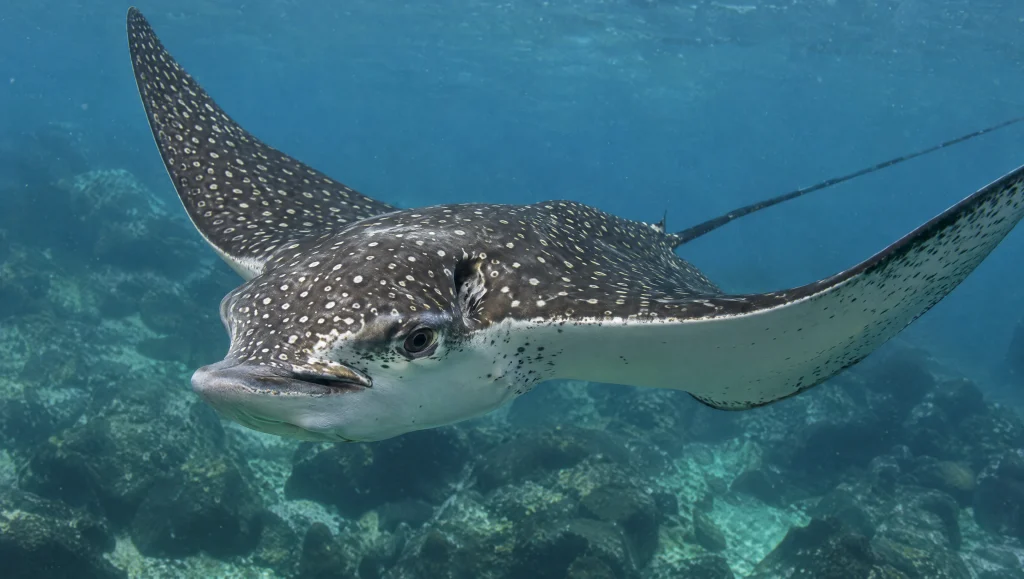
Overview
A striking ray frequently seen gliding through Galápagos waters, easily identified by the white spots scattered across its dark back.
Physical Characteristics
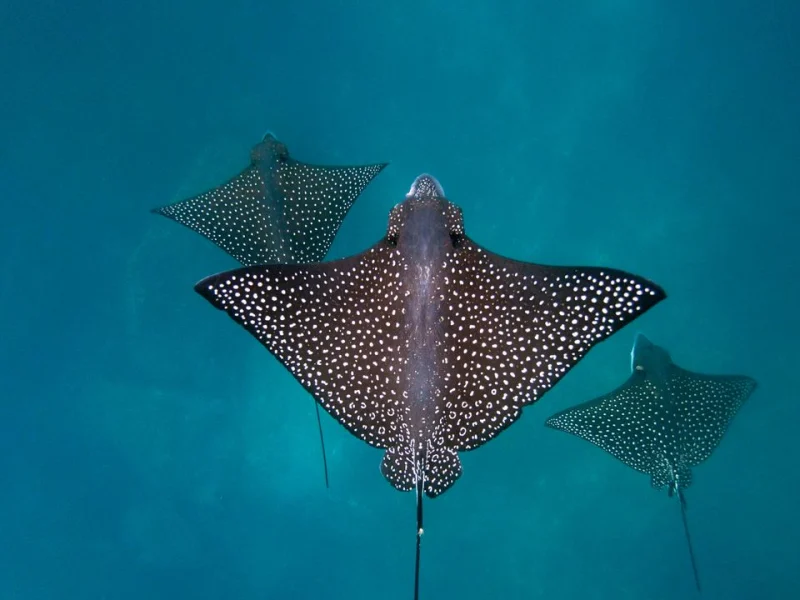
A flattened, diamond-shaped body, dark bluish-grey to black on top with distinctive white spots and rings, a long whip-like tail that can exceed the body in length, and a rounded, duck-bill-shaped snout.
Habitat
Coastal and open waters over sandy bottoms, occasionally near reefs.
Distribution
Circumtropical, and commonly encountered throughout Galápagos waters.
Diet
Mollusks, crustaceans, and small fish.
Hunting Behaviour
Uses its flattened snout to dig into sand and expose buried prey such as clams and shrimp, crushing their shells with powerful plate-like teeth.
Reproduction
Ovoviviparous, giving live birth to small litters of up to about four pups after a gestation of roughly a year.
Social Behaviour
Often seen swimming alone or in small groups, sometimes called a “fever” of rays, and occasionally leaping clear of the water.
When to Observe It
Seen year-round while snorkeling or diving in coastal Galápagos waters.
Evolution
Rays are close relatives of sharks, sharing a cartilaginous skeleton; the eagle ray’s streamlined body reflects an adaptation to open-water gliding rather than the bottom-hugging style of many other ray species.
Conservation
Listed as Endangered by the IUCN, primarily due to bycatch and habitat degradation across its global range.
Galápagos Connection
A regularly encountered highlight of snorkeling excursions included on most Galápagos cruise itineraries.
Naturalist Insight
Despite their graceful, gentle appearance, spotted eagle rays are known to leap fully clear of the water. Researchers still debate whether this breaching behaviour serves to dislodge parasites, communicate with other rays, or simply serves no function beyond exertion.
At a Glance
| Scientific Name | Aetobatus narinari |
|---|---|
| Typical Size | Disc width up to ~3 m |
| Diet | Mollusks, crustaceans, small fish |
| Conservation Status | Endangered (IUCN) |
Observe it on
More Species to Discover
A lifetime of Galápagos knowledge, gathered into one ebook.
Receive the EbookCurated by naturalists born in the Galápagos — see who's behind this knowledge