

King Angelfish
Overview
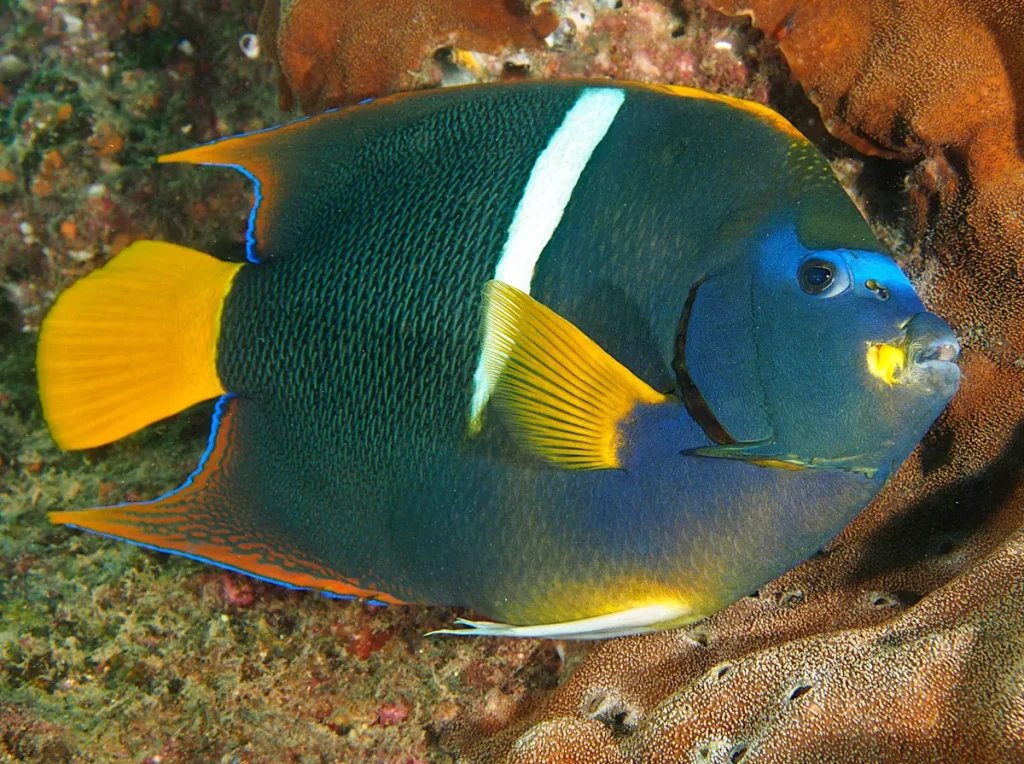
The king angelfish is one of the most visually striking reef fish in the Galápagos, made even more remarkable by a dramatic change in coloration between its juvenile and adult stages.
Physical Characteristics
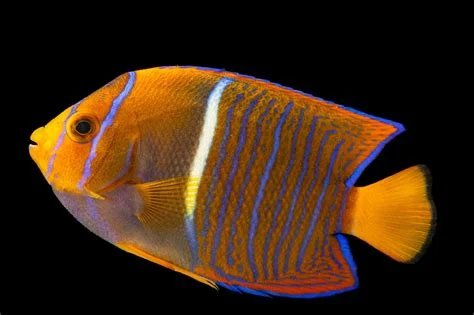
Adults are deep blue to near-black with a bold white diagonal bar across the body and vivid yellow tail and pectoral fins; juveniles look like an entirely different species, with a bright orange body crossed by electric-blue stripes.
Habitat
Rocky reefs and volcanic structure with plentiful crevices and ledges to retreat into when threatened.
Distribution
Common throughout the tropical Eastern Pacific from the Gulf of California to Peru, including the Galápagos.
Diet
Feeds mainly on sponges and tunicates, along with algae, grazing steadily across reef surfaces.
Feeding Behaviour
Picks food directly off reef structure with a small, specialized mouth, often working the same territory repeatedly as an adult.
Reproduction
Forms pairs or small harems; spawning takes place in the water column, releasing eggs and sperm that drift with the current rather than being guarded on the reef.
Growth & Color Change
The juvenile’s orange-and-blue pattern gradually gives way to the adult’s dark blue-and-yellow coloring over roughly the first year of life — a transformation so complete that juveniles were historically mistaken for a separate species entirely.
When to Observe It
Common and easy to see on almost any Galápagos reef dive or snorkel, both as solitary adults and, less often, as juveniles tucked into crevices.
Evolution
The stark juvenile-to-adult color change is thought to reduce aggression from territorial adults, since a juvenile that looks nothing like a rival is less likely to be challenged while it grows large enough to hold its own territory.
Conservation
Listed as Least Concern, with healthy populations throughout its range.
Galápagos Connection
The king angelfish’s dramatic transformation is a favorite subject for underwater photographers and naturalist guides alike, since spotting both a juvenile and an adult on the same dive gives visitors a rare, direct look at how differently the same species can appear across its life stages.
Naturalist Insight
A juvenile king angelfish’s orange-and-blue coloring is so different from the adult’s that early naturalists cataloguing Eastern Pacific reef fish sometimes described the two as separate species — it took closer observation of individuals transitioning between the two color patterns to confirm they were one and the same fish.
At a Glance
| Scientific Name | Holacanthus passer |
|---|---|
| Typical Size | Up to 38 cm |
| Diet | Sponges, tunicates, algae |
| Conservation Status | Least Concern (IUCN) |
More Species to Discover
A lifetime of Galápagos knowledge, gathered into one ebook.
Receive the EbookCurated by naturalists born in the Galápagos — see who's behind this knowledge