

An ecosystem shaped by isolation, currents and time.
The Galápagos are not simply a collection of islands. They are the result of a remarkable interaction between volcanic geology, ocean currents, isolation and evolution.
Cold, nutrient-rich waters rise from the depths and sustain an extraordinary marine ecosystem. At the same time, the isolation of the islands allowed species to evolve in remarkably different directions. This combination created one of the most extraordinary natural laboratories on Earth.
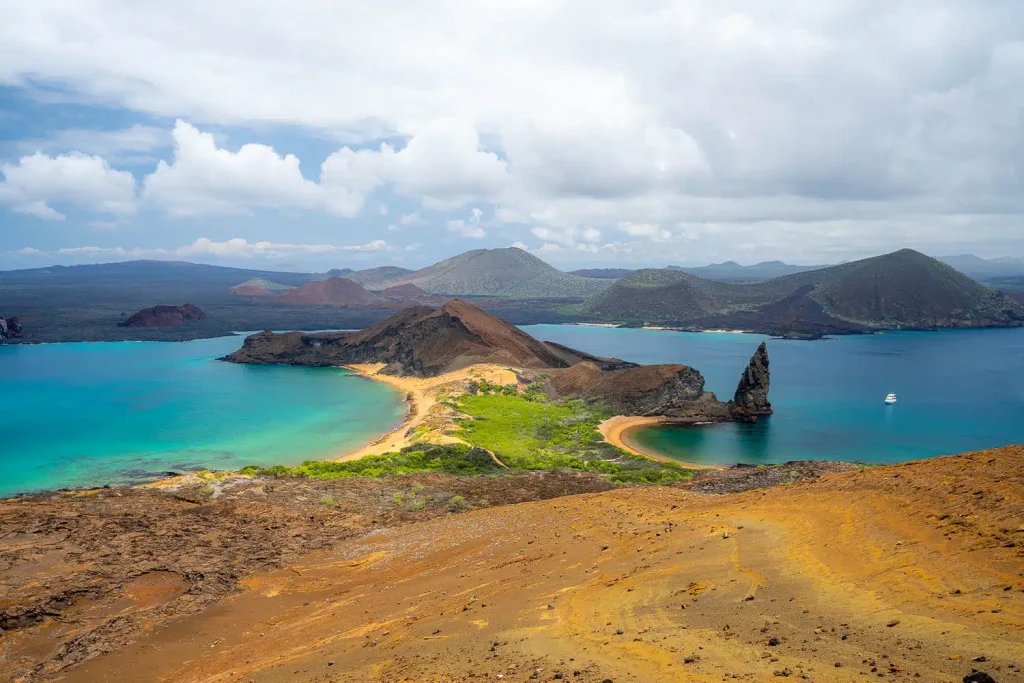
Isolation and endemism
Roughly 1,000 km of open ocean separate the archipelago from mainland South America. Species that made the crossing found little competition and few predators, and evolved independently — often island by island — producing the high endemism the Galápagos are known for.
Volcanism
Every island is volcanic in origin. The archipelago sits over a stationary hotspot while the ocean floor drifts slowly above it, continually building new islands to the west while older ones erode in the east.
Where cold and warm currents meet
The cold, nutrient-rich Humboldt Current flows up from the south, while the Panama Current brings warmer water from the north. The Cromwell Current (an equatorial undercurrent) collides with the western islands and forces cold, nutrient-rich water upward — a process called upwelling. It is this rare meeting of cold and warm water, at the equator, that lets penguins, fur seals and cold-water fish share the same waters as tropical corals and reef fish.
El Niño and adaptation
Periodic El Niño events warm the surrounding ocean and suppress the upwelling that marine species depend on, sometimes causing sharp die-offs. Marine iguanas are known to cope with the resulting food scarcity through a striking adaptation — measurably shrinking their own body length and reabsorbing bone tissue, then regrowing it once conditions improve.
A Timeline of the Islands
From volcanic origin to protected archipelago.
A hotspot builds an archipelago
The Galápagos sit atop a volcanic hotspot in the Earth's mantle. As the Nazca tectonic plate drifts slowly east, it carries older islands away from the hotspot while new ones rise in their place — which is why the eastern islands (like Española and San Cristóbal) are the oldest and most eroded, and the western islands (Fernandina and Isabela) are the youngest and still volcanically active today.
Life arrives against the odds
Roughly 1,000 km (600 miles) from the South American mainland, the islands were never connected to a continent. Every plant and animal that established itself here had to cross open ocean — rafting on vegetation, carried by wind, or swimming and flying extraordinary distances. Successful arrivals were rare, but once established, species evolved in isolation with little competition, producing the archipelago's remarkable endemism.
European discovery
The Bishop of Panama, Tomás de Berlanga, sighted the islands by accident while sailing to Peru. He named the giant tortoises he found there "galápagos" — the old Spanish word for saddle, after the shape of their shells — and the name stayed with the archipelago.
Pirates, whalers and tortoises
For nearly three centuries the islands served as a hideout and resupply stop for pirates and, later, whaling ships. Giant tortoises were taken aboard by the thousands as a source of fresh meat, since they could survive many months without food or water — a practice that devastated several island populations.
Ecuador claims the archipelago
Ecuador formally annexed the Galápagos, and General José de Villamil established the first permanent settlement on Floreana. Several islands were later used as penal colonies, including a particularly harsh one on Isabela.
Darwin's five weeks
Charles Darwin visited the islands aboard HMS Beagle for about five weeks. His observations of the finches, mockingbirds and giant tortoises — each subtly different from island to island — became central evidence in the theory of evolution by natural selection, published in On the Origin of Species in 1859.
The National Park is born
One hundred years after Darwin's book, Ecuador declared roughly 97% of the archipelago's land area a national park, and the Charles Darwin Foundation was established the same year to support science and conservation in the islands.
A World Heritage Site
UNESCO inscribed the Galápagos Islands as one of the very first sites on its World Heritage List, recognizing their exceptional and largely intact ecosystems.
Protecting the ocean, too
The Galápagos Marine Reserve was created, placing the waters surrounding the archipelago among the largest marine protected areas in the world at the time — extending conservation from the islands themselves to the currents and marine life that sustain them.
Conservation and careful tourism
Regulated tourism — licensed naturalist guides, fixed visitor sites, controlled group sizes — has become the islands' main economic driver, alongside ongoing conservation work: removing introduced species, breeding and repatriating giant tortoises, and monitoring the effects of climate change and El Niño on this uniquely fragile ecosystem.