

Galápagos Shark
Overview
The Galápagos shark is a large, powerful requiem shark first formally described from specimens collected in the islands that bear its name, though it is now known to range around oceanic islands throughout the tropical and subtropical world.
Physical Characteristics
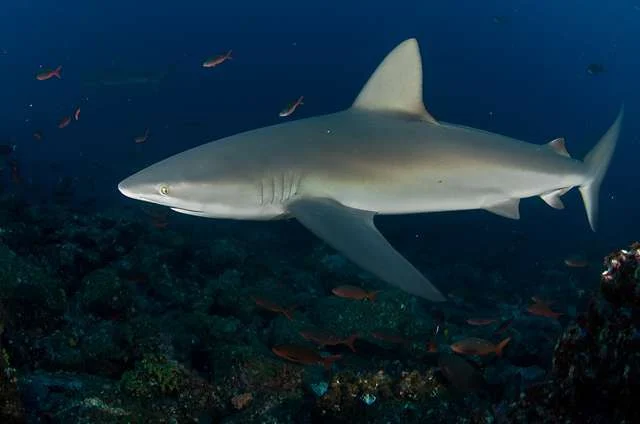
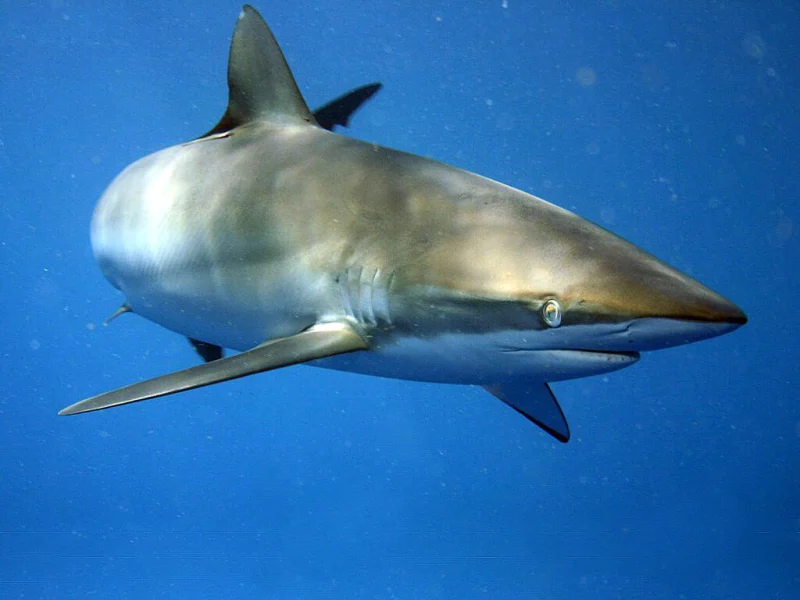
A classic, robust requiem-shark build: grey above, pale below, with a broadly rounded snout and a tall, slightly curved first dorsal fin positioned well forward on the body.
Habitat
Rocky reefs and steep underwater walls around oceanic islands, particularly where strong currents concentrate baitfish and other prey.
Distribution
Within the Galápagos Marine Reserve, most reliably encountered around the remote northern islands of Darwin and Wolf, where nutrient-rich currents support some of the richest shark aggregations in the archipelago.
Diet
A generalist predator, feeding on reef fish, other sharks, rays, and occasionally marine mammals such as sea lions.
Hunting Behaviour
Typically hunts alone or in loose aggregations rather than tightly coordinated groups, patrolling reef edges and current lines where prey concentrates.
Reproduction
Viviparous, giving birth to live litters of roughly 6 to 16 pups after a gestation period thought to last around a year.
Social Structure
Often seen in loose schools or aggregations around productive reef structures, particularly at well-known sites like Darwin’s Arch, though these gatherings are feeding aggregations rather than tight social groups.
When to Observe It
Most reliably seen on dedicated dive excursions to Darwin and Wolf, generally in deeper, current-swept water rather than shallow snorkeling sites.
Evolution
As a wide-ranging oceanic-island specialist, the Galápagos shark’s global distribution around isolated island groups — rather than continental coastlines — reflects a strong ecological preference for the reef and current conditions found around remote volcanic islands.
Conservation
Listed as Near Threatened, primarily due to fishing pressure — including targeted shark-fin fishing — in areas outside protected reserves; populations within the well-enforced Galápagos Marine Reserve remain comparatively healthy.
Galápagos Connection
The shark aggregations around Darwin and Wolf are one of the primary reasons the Galápagos Marine Reserve is considered one of the world’s foremost shark diving destinations.
Naturalist Insight
The Galápagos shark’s scientific description was based on specimens from these islands, but its true range spans oceanic islands across the globe — a reminder that “Galápagos” in a species name sometimes marks where science first found an animal, not necessarily where it exclusively lives.
At a Glance
| Scientific Name | Carcharhinus galapagensis |
|---|---|
| Typical Size | Up to 3.7 m |
| Diet | Fish, other sharks, rays, occasionally sea lions |
| Conservation Status | Near Threatened (IUCN) |
Observe it on
More Species to Discover
A lifetime of Galápagos knowledge, gathered into one ebook.
Receive the EbookCurated by naturalists born in the Galápagos — see who's behind this knowledge