

Galápagos Fur Seal
Overview
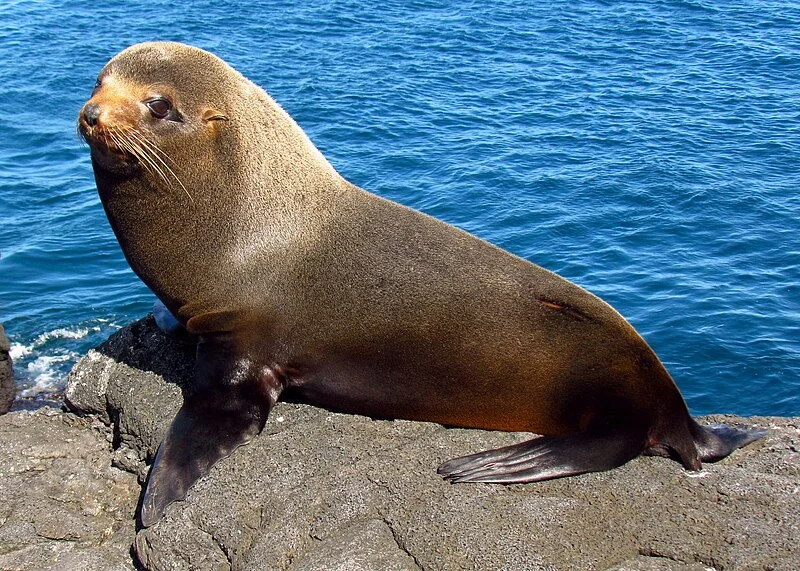
The Galápagos fur seal is often mistaken for the more commonly seen Galápagos sea lion, but it is a distinct, smaller species with its own specialized biology — the smallest fur seal, and the smallest of all eared seals, anywhere in the world.
Physical Characteristics
A thick double coat of fur — the trait that nearly caused its extinction, see Conservation — along with noticeably larger eyes and a shorter, more pointed muzzle than the sea lion, adaptations that support the fur seal’s largely nocturnal lifestyle.
Habitat
Rocky, often steep and shaded coastlines and lava grottoes, generally avoiding the open sandy beaches favored by sea lions — a preference that helps the thickly-furred fur seal avoid overheating in direct equatorial sun.
Distribution
Found on rockier stretches of coastline across much of the archipelago, typically in smaller, more dispersed groups than the large, conspicuous sea lion colonies.
Diet
Primarily squid and fish, especially species that migrate toward the surface at night.
Hunting Behaviour
Unlike the sea lion, the fur seal forages mostly at night, diving to intercept fish and squid that rise toward the surface after dark — a strategy that lets it exploit food resources with less direct competition from sea lions, which forage more by day.
Reproduction
Females give birth to a single pup and nurse it for an unusually long period — up to two to three years, among the longest lactation periods of any pinniped — with delayed implantation extending the overall reproductive cycle further still.
Courtship
Territorial bulls patrol and defend stretches of rocky shoreline rather than large open-beach harems, generally holding smaller territories with fewer females than a typical sea lion bull.
When to Observe It
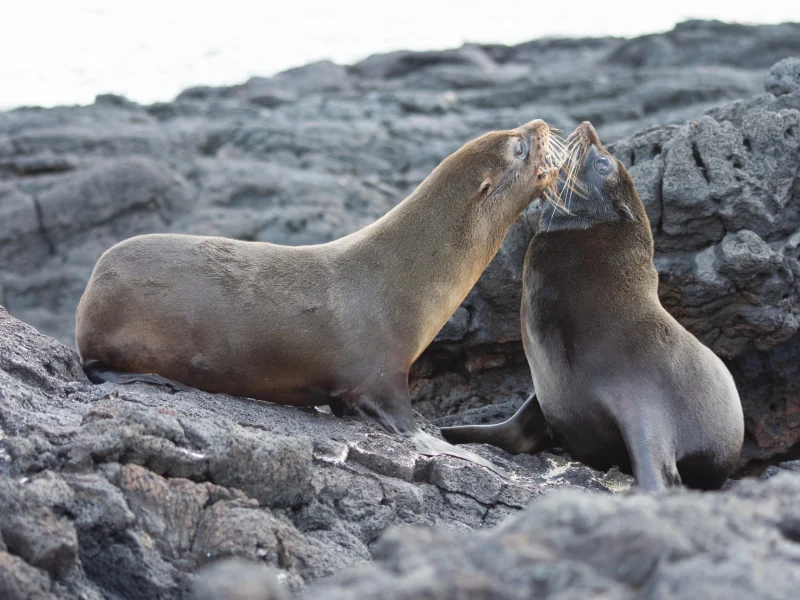
Best looked for in shaded rocky coves and lava grottoes rather than open beaches — Isabela and Fernandina’s rockier shorelines are good places to watch, often quietly resting in the shade during the heat of the day.
Evolution
Fur seals and sea lions diverged from a common ancestor, with fur seals generally retaining a denser insulating coat suited to colder ancestral ranges — a trait the Galápagos fur seal now manages in a tropical climate through nocturnal foraging and shade-seeking rather than through fur loss.
Conservation
Hunted heavily for its valuable fur through the 18th and 19th centuries, the species was pushed to the edge of extinction before international protection allowed a slow recovery. It remains listed as Endangered, and, like the Galápagos sea lion, is sensitive to El Niño-driven food shortages.
Galápagos Connection
The fur seal’s history is a direct, sobering counterpoint to the giant tortoise and land iguana recovery stories — a reminder that the archipelago’s wildlife protections exist because several species came very close to being lost entirely.
Naturalist Insight
Because it forages mainly after dark, a fur seal is far more likely to be encountered resting quietly in a shaded rocky crevice during the day than swimming energetically offshore — patient, careful looking into shadowed coastal nooks, rather than scanning open water, is usually what turns up a sighting.
At a Glance
| Scientific Name | Arctocephalus galapagoensis |
|---|---|
| Typical Size | Up to 1.5 m, up to 65 kg — the smallest fur seal species and smallest otariid in the world |
| Diet | Squid and fish, hunted mainly at night |
| Conservation Status | Endangered (IUCN) |
Observe it on
More Species to Discover
A lifetime of Galápagos knowledge, gathered into one ebook.
Receive the EbookCurated by naturalists born in the Galápagos — see who's behind this knowledge