

Green Moray Eel
Overview
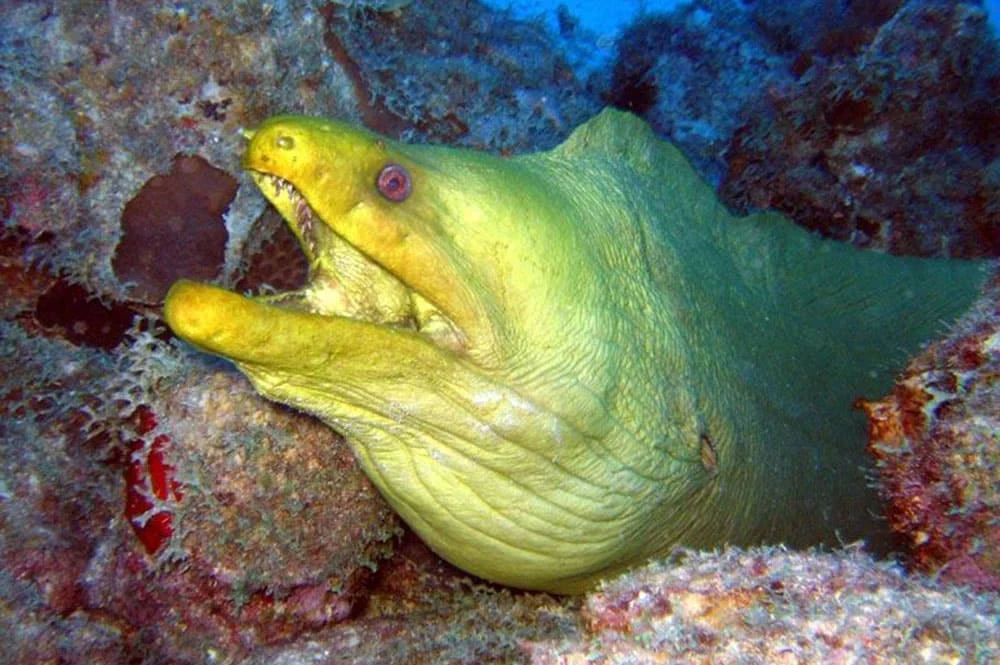
The green moray eel is one of the largest eel species found in the Galápagos, usually seen with just its head protruding from a rocky crevice, mouth opening and closing in a motion that looks threatening but is simply how it breathes.
Physical Characteristics
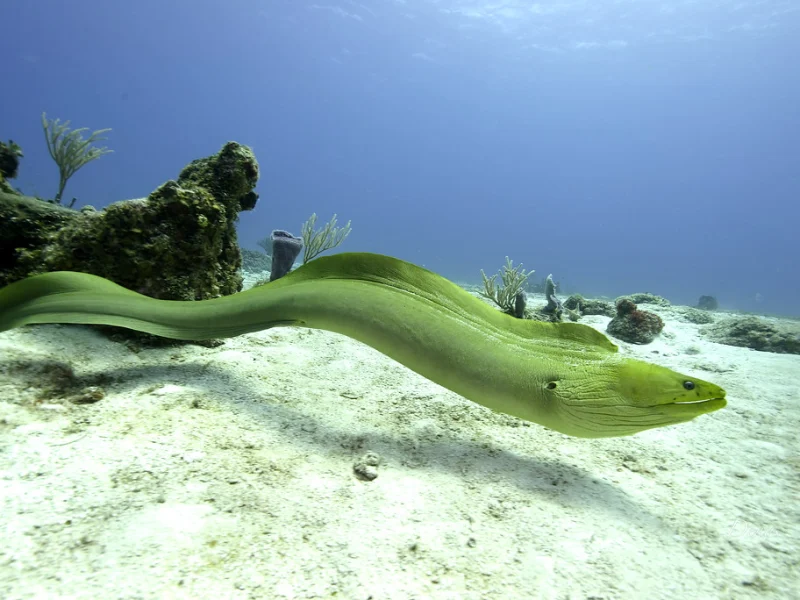
Despite its name, the moray’s skin is actually a dull brown or grey — the green appearance comes from a protective yellow mucus coating over its skin combined with a blue pigment underneath, which together give it its distinctive color.
Habitat
Rocky reefs and crevices, wrecks, and other structure offering tight hiding spots during the day.
Distribution
Found throughout the tropical Western Atlantic and Eastern Pacific, including reefs across the Galápagos.
Diet
Fish, octopus, and crustaceans, generally hunted opportunistically rather than through active pursuit.
Hunting Behaviour
Relies primarily on smell rather than eyesight, which is relatively poor — it locates prey by scent and often hunts most actively after dark, ambushing prey that ventures within striking range of its crevice.
Reproduction
Little is known in detail about wild breeding behaviour; like other moray eels, it is thought to release eggs and sperm into open water, with larvae drifting as plankton before eventually settling onto a reef.
Behaviour
The open-mouthed posture so often photographed is not aggression but respiration — morays lack the gill-pumping muscles of most fish and must actively open and close their mouths to move water over their gills.
When to Observe It
Common and easy to find on almost any Galápagos reef dive, usually as just a head poking from a crevice; full-body sightings while swimming in the open are less frequent but do occur.
Evolution
The moray’s elongated, limbless body and reliance on smell over eyesight reflect a lineage well adapted to hunting within tight reef crevices, where a rigid, laterally-swimming body plan like a typical fish’s would be far less maneuverable.
Conservation
Listed as Least Concern, with stable, widespread populations across its range.
Galápagos Connection
Green morays are a reliable, easy-to-spot highlight on almost any Galápagos snorkel or dive, and a good opportunity for naturalist guides to correct the common misconception that their open-mouthed look signals aggression.
Naturalist Insight
A moray eel’s constantly opening and closing mouth is one of the most common cases of misread animal body language on a Galápagos snorkel — it’s simply breathing, using its jaw to actively pump water over its gills since it lacks the gill-cover muscles most fish use for the same job.
At a Glance
| Scientific Name | Gymnothorax funebris |
|---|---|
| Typical Size | Up to 2.5 m |
| Diet | Fish, octopus, crustaceans |
| Conservation Status | Least Concern (IUCN) |
More Species to Discover
A lifetime of Galápagos knowledge, gathered into one ebook.
Receive the EbookCurated by naturalists born in the Galápagos — see who's behind this knowledge