

Galápagos Grouper
Overview
Known locally as “bacalao,” the Galápagos grouper is an endemic reef fish that was historically one of the most important food fish in the islands — a status that, combined with a vulnerable breeding strategy, has driven it to the brink of extinction.
Physical Characteristics
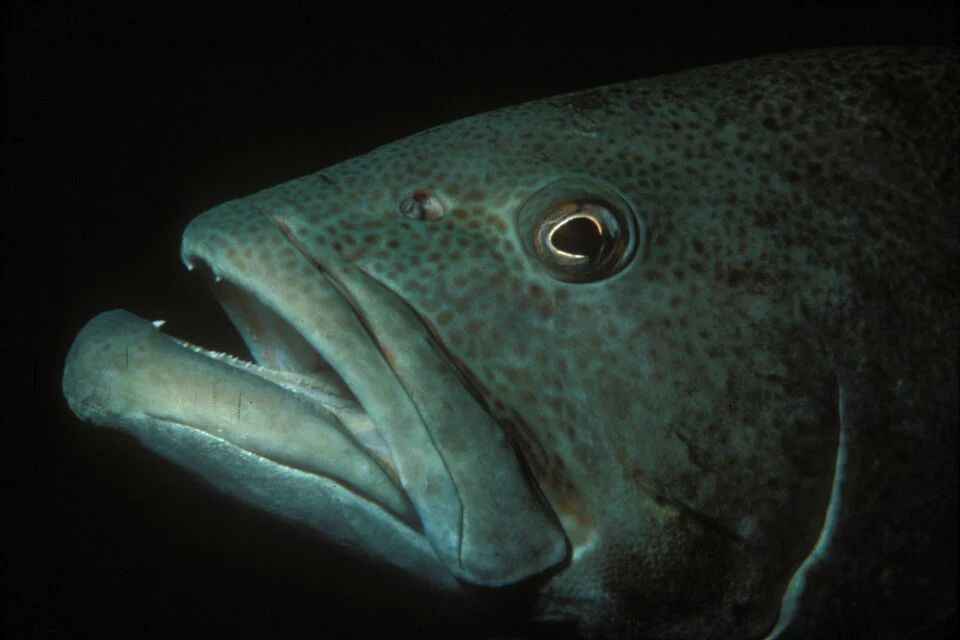
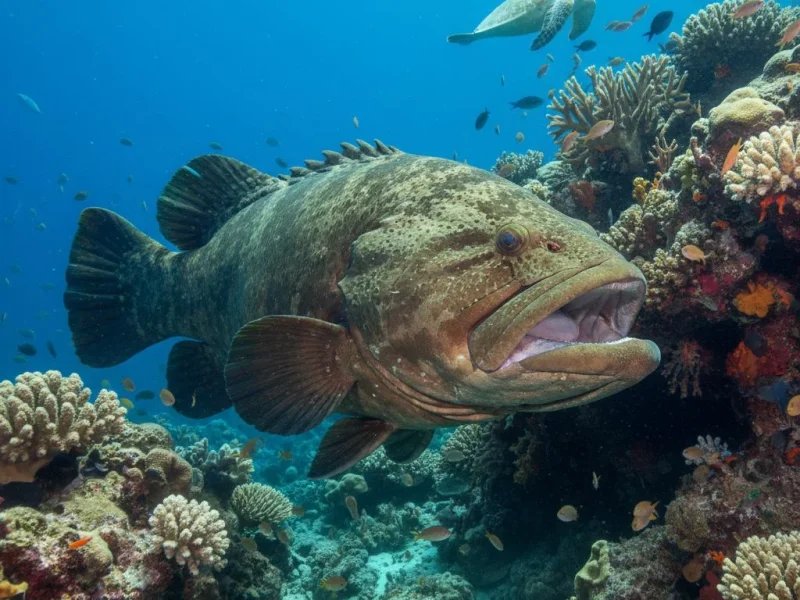
A large, heavy-bodied grouper with a broad head and mouth, mottled brown-to-grey coloring that provides camouflage against rocky reef backgrounds, and a noticeably blunt, powerful jaw.
Habitat
Rocky reefs and underwater structure throughout the archipelago, typically as a solitary, territorial resident of a particular reef area outside the breeding season.
Distribution
Found only in Galápagos waters, historically common on reefs archipelago-wide, though numbers have declined sharply from historic levels.
Diet
An ambush predator, feeding mainly on smaller reef fish and crustaceans from a stationary or slow-moving position near reef structure.
Reproduction
A protogynous hermaphrodite — individuals begin life as females and some later transition to male — that gathers in large spawning aggregations at specific reef sites and times of year, a reproductive strategy that proved catastrophically vulnerable to targeted fishing once those aggregation sites became known.
Feeding Behaviour
Relies on camouflage and patience rather than pursuit, striking suddenly at prey that strays close enough to its position on the reef.
When to Observe It
Increasingly uncommon; sightings are most likely on undisturbed, well-protected reef sites away from historic fishing grounds.
Evolution
Its endemic status and unusually restricted range make the Galápagos grouper a clear example of how isolation can produce a species finely tuned to a small marine area — and just as vulnerable when that same restricted range is exploited intensively.
Conservation
Listed as Critically Endangered — spawning aggregation fishing during the 20th century sharply reduced numbers, and the species remains a conservation priority for the Galápagos National Park and Marine Reserve, including protection of known spawning sites.
Galápagos Connection
The bacalao’s decline is one of the clearest cautionary tales in the islands’ marine history — proof that even a species with no land-based threats at all can be pushed to the edge purely through fishing pressure on a narrow reproductive vulnerability.
Naturalist Insight
Because the Galápagos grouper changes sex from female to male over its lifetime, removing the largest individuals from a population — exactly the fish spawning-aggregation fishing tends to target — disproportionately removes breeding males, compounding the damage to reproduction far beyond what raw numbers alone would suggest.
At a Glance
| Scientific Name | Mycteroperca olfax |
|---|---|
| Typical Size | Up to 1 m, up to 20 kg |
| Diet | Fish, crustaceans |
| Conservation Status | Critically Endangered (IUCN) |
More Species to Discover
A lifetime of Galápagos knowledge, gathered into one ebook.
Receive the EbookCurated by naturalists born in the Galápagos — see who's behind this knowledge